
Diya Malik
Experienced Economics tutor helping in concept building with practical relevance and grade improvement
Loading...






Show all photos
Diya Malik
Bachelors degree
Enroll after the free trial
Each lesson is 55 min
50 lessons
20% off
/ lesson
30 lessons
15% off
/ lesson
20 lessons
10% off
/ lesson
10 lessons
5% off
/ lesson
5 lessons
-
/ lesson
1 lessons
-
/ lesson
About your economics tutor
I am Diya Malik from India, a graduate in Economics from Lady Shri Ram College for Women (ranked among the top 5 Economics colleges in India). With over 2 years of teaching experience, I specialize in helping students who find Economics challenging, especially those with anxiety or low confidence in the subject. I believe that no subject is inherently difficult—what matters is generating interest and building strong foundations. My teaching journey began by assisting peers during school and college, and has grown into professional tutoring with expertise in Microeconomics, Macroeconomics, and International Economics. I have also qualified GATE (one of the 3rd most difficult exams in India), which adds depth to my subject knowledge. Who I Teach: School students (Economics fundamentals & exam prep); College students (core & advanced Economics); Anyone seeking to build or strengthen their Economics knowledge Special Focus: Students struggling with fear, anxiety, or weak concepts in Economics. Teaching Methodology: Step-by-step approach- from foundation to advanced (customized lessons as per student needs), Simplifying complex concepts with real-life examples, case studies, and interactive discussions, Focus on both subject clarity and mental confidence for grade improvement, Support with recorded classes, structured notes, Q&A discussions, assessments, and quizzes Tools: Digital board, presentations, quizzes, and assessments for engaging learning My mission is to make Economics easy, relatable, and confidence-building for every learner.
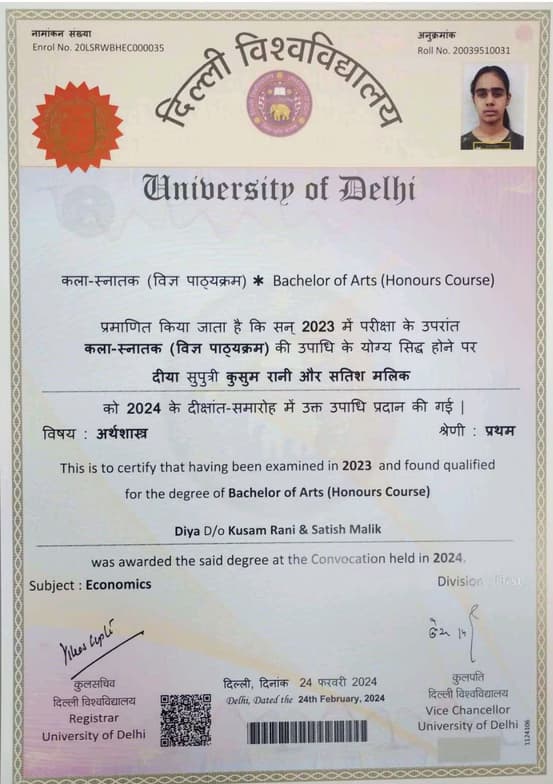
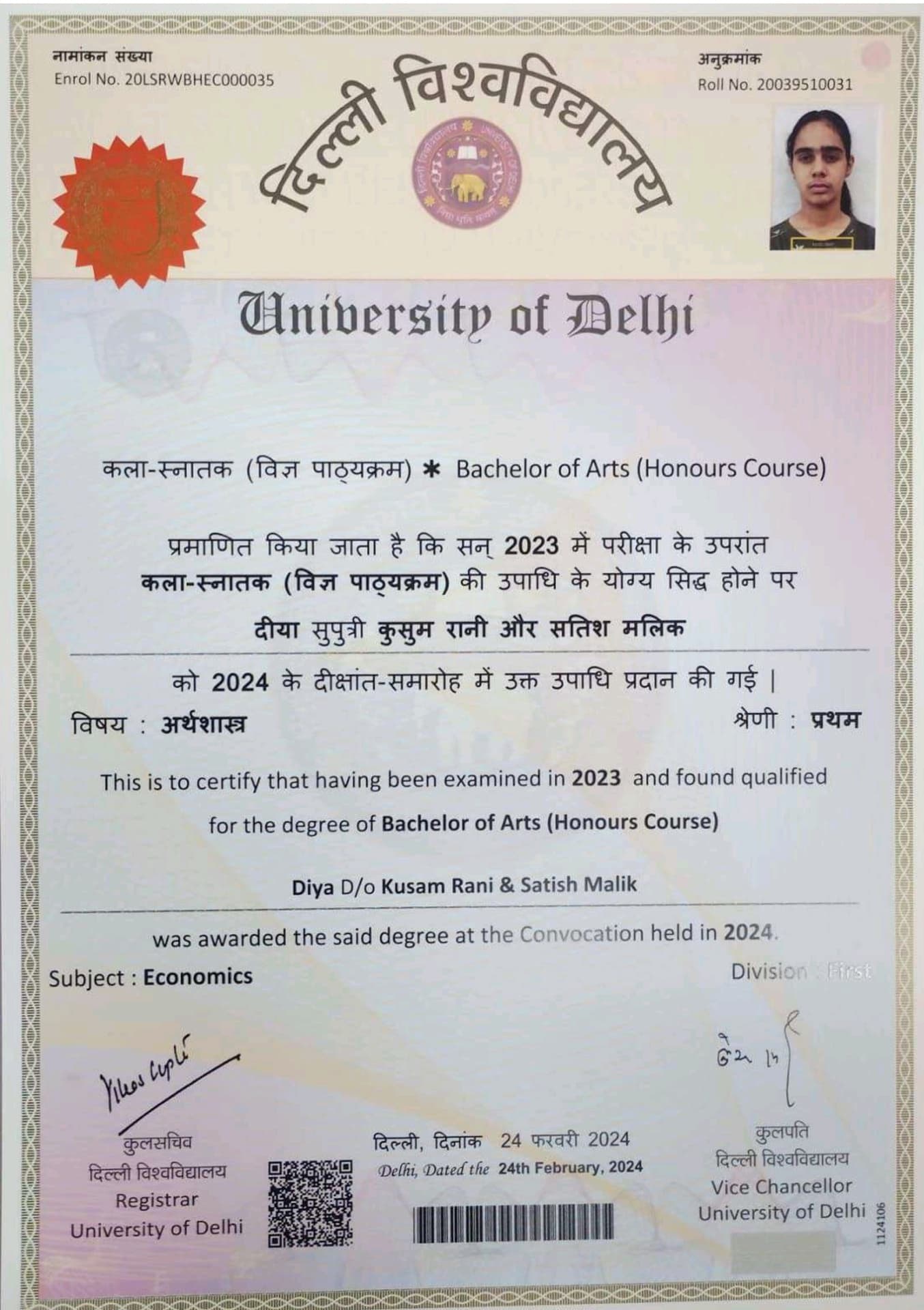
Diya graduated from Lady Shri Ram College for Women, University of Delhi

Academic expertise of your economics tutor

Homework help

Customized learning plans

Review sessions

Test prep
Real world application
Student types for economics class

College students
High School students
Economics class quick guide
My teaching methodology covers foundation to advanced levels, offering adaptable lessons customized to suit each student’s pace and learning style. I focus on simplifying complex concepts to promote clarity, understanding, and lasting confidence, while linking topics with real-life examples, case studies, and interactive discussions. Beyond academics, I emphasize mental well-being as a key factor in improving focus, motivation, and grades. Lessons include structured discussions, systematic note-making through engaging presentations, use of digital boards for better visualization, and regular quizzes for practice and reinforcement. This comprehensive, student-centered, and holistic approach enhances subject mastery, sharpens critical thinking, boosts confidence, and ensures long-term academic excellence and success.
Your economics tutor also teaches

Economics
Macroeconomics
Microeconomics
Market Structures
Supply and Demand
Economic Policy
Flexible Scheduling
Allows 1h early scheduling
Allows 1h early rescheduling
Can wait for 20 mins after joining

.svg)
10 day Refund
.svg)
Free Tutor Swap

Economics concepts taught by Diya
The Tutor explained the concept of the loanable fund market, detailing the roles of savers as suppliers and borrowers as demanders, and how interest rates influence these dynamics. The Tutor and Student practiced identifying shifts in demand and supply curves and their impact on equilibrium interest rates and quantities, using various economic scenarios and diagrams.
Loanable Funds Market
Interest Rates and Investment Decisions
Shifts in Demand and Supply
The session reviewed the production function and technological progress before delving into the core concepts of savings, investment, and the financial system. The tutor explained the saving-investment identity in closed and open economies, detailing private, government, and national savings, and the implications of capital flows. The next steps involve further examples and discussion of these macroeconomic principles.
Open Economy: Capital Flows
The Saving-Investment Identity
Savings
Investment
and the Financial System
Production Function
Technological Progress
The Tutor and Student reviewed fundamental economic principles, starting with the definition of economics and its branches (micro and macro). They practiced distinguishing between positive and normative statements and explored the concept of opportunity cost, including its calculation in various scenarios. The session concluded with an examination of the production possibility frontier (PPF) and factors that cause it to shift or rotate.
Positive vs. Normative Economics
Opportunity Cost
Production Possibility Frontier (PPF)
Sunk Costs
The Tutor and Student reviewed fundamental macroeconomic concepts including aggregate demand/supply, GDP (nominal vs. real, per capita), and the limitations of GDP as a welfare measure. They also covered the definition and calculation of the unemployment rate, the inverse relationship between GDP growth and unemployment, and the calculation of price indices and inflation rates. The next session will focus on Prior Year Questions (PYQs) after covering two more chapters.
Nominal vs. Real GDP
Relationship between GDP Growth and Unemployment
Price Index and Inflation
GDP Per Capita
Unemployment Rate
The session covered the definition and calculation methods of Gross Domestic Product (GDP), including the production, expenditure, and income approaches. The Student practiced identifying components of GDP and differentiating between nominal and real GDP, with a focus on avoiding double-counting and understanding inflation's impact.
Exclusions from GDP Calculation
Nominal vs. Real GDP
Methods of GDP Calculation
GDP Definition and Components
The Tutor and Student discussed the basics of macroeconomics, focusing on national accounts, GDP, and the circular flow model. The session included definitions of key economic terms and an explanation of how money flows through different sectors of an economy using the circular flow diagram. No specific homework was assigned, but the Tutor will provide notes for review.
Importance of Economic Measurement
Factors of Production
The Circular Flow Diagram
National Accounts
Macro vs. Microeconomics
Key Macroeconomic Terms
Learning tools used by economics tutor

Assessments

Digital whiteboard

Quizzes
Interactive economics lessons

Note taking

Mobile joining

Open Q&A

Record lessons

Parent feedback

Economics tutors on Wiingy are vetted for quality
Every tutor is interviewed and selected for subject expertise and teaching skill.