
SHREYA SAXENA
Experienced Economics Educator | 8+ Years Teaching Guiding Students Toward Strong Concepts & Top Results
Loading...






Show all photos
SHREYA SAXENA
Masters degree
Enroll after the free trial
Each lesson is 55 min
50 lessons
20% off
/ lesson
30 lessons
15% off
/ lesson
20 lessons
10% off
/ lesson
10 lessons
5% off
/ lesson
5 lessons
-
/ lesson
1 lessons
-
/ lesson
About your economics tutor
I am Shreya Saxena, a dedicated and accomplished Economics educator with over eight years of teaching experience across multiple academic levels, including Grades 9 to 12, undergraduate, and postgraduate programs. Throughout my teaching journey, I have consistently guided students toward academic excellence and conceptual mastery in Economics. My approach blends clarity of fundamentals, analytical thinking, and real-world application, helping learners not only excel in examinations but also develop a lasting appreciation for the subject. I take pride in creating an intellectually stimulating classroom environment where students are encouraged to think critically, question deeply, and connect economic theories with practical scenarios. Over the years, many of my students have achieved top grades and pursued higher studies in reputed institutions, a testament to the effectiveness of my teaching methods. With a strong commitment to academic rigor and personalized guidance, I strive to empower every learner to reach their fullest potential in the fascinating discipline of Economics.
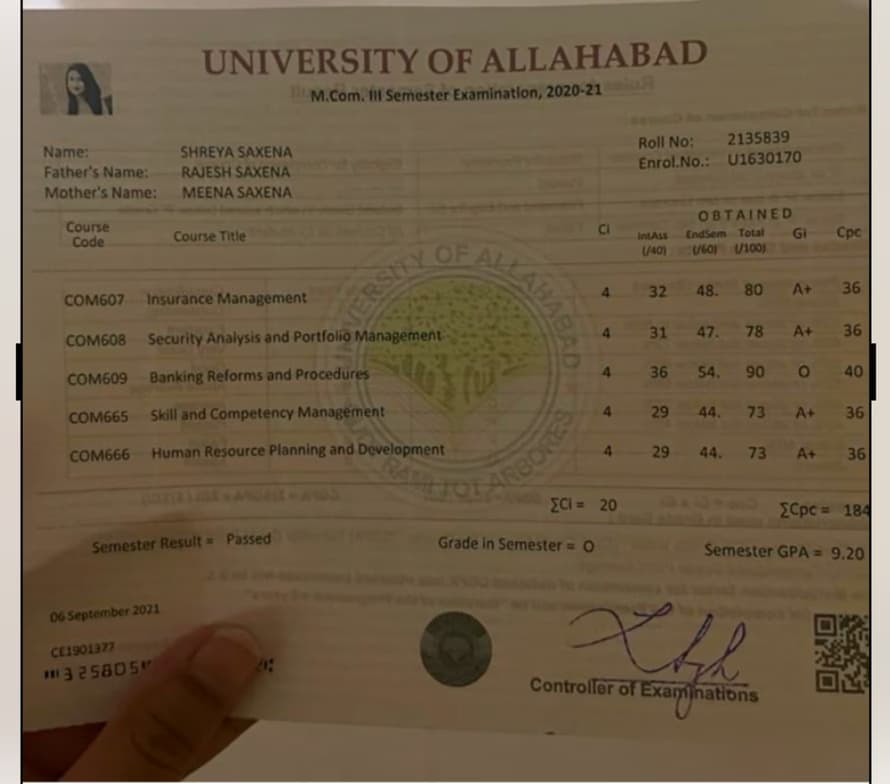
SHREYA graduated from UNIVERSITY OF ALLAHABAD


Academic expertise of your economics tutor

Test prep

Review sessions

Economics research

Case study analysis

Publication in journals

Customized learning plans
Student types for economics class

Economics for School students
Economics for Beginners
Economics for Kids
Economics class quick guide
Key elements of my approach include: Concept-Based Learning: I focus on strengthening the core foundations of Microeconomics and Macroeconomics through clear explanations, visual aids, and simplified models. Applied Understanding: Real-life case studies, current economic events, and data interpretation exercises are integrated into lessons to bridge the gap between theory and practice. Interactive Pedagogy: My sessions encourage discussion, debate, and inquiry-based learning to promote critical thinking and active participation. Exam-Oriented Strategy: I provide structured notes, practice questions, and past-paper analysis to help students develop confidence and precision in examinations. Differentiated Instruction: Recognizing that every learner is unique, I tailor my teaching pace, examples, and assessments according to individual learning needs. Continuous Evaluation: Regular feedback, mock tests, and performance tracking help students monitor their progress and identify areas of improvement. This methodology not only equips students with a strong academic foundation but also nurtures economic reasoning, analytical ability, and independent thought, ensuring excellence at every level of study.
Your economics tutor also teaches

Economics
Macroeconomics
Microeconomics
Supply and Demand
Flexible Scheduling
Allows 1h early scheduling
Allows 1h early rescheduling
Can wait for 20 mins after joining

.svg)
10 day Refund
.svg)
Free Tutor Swap

Economics concepts taught by SHREYA
The tutor and student worked through a game theory problem from a past question paper, focusing on deriving the strategic form of an extensive form game and identifying Nash equilibria. They practiced defining complete strategies and determining best responses to find the equilibrium. The next class is planned for Tuesday, April 7th, to continue with question two.
Extensive Form Games and Strategic Form Conversion
Strategies in Game Theory
Nash Equilibrium
Dominated Strategies
Oligopoly Pricing
The Student and Tutor reviewed chapter 14 of their course materials, focusing on taxation and income distribution. They discussed the principles of taxation, including Adam Smith's four cannons (equity, certainty, convenience, economy), and different tax structures like progressive, proportional, and regressive taxation. They also briefly covered the equal sacrifice and benefits principles, planning to continue with remaining topics in the next session.
Principles of Taxation (Adam Smith's Canons)
Types of Taxation Based on Tax Rate Changes
Equal Sacrifice Principle of Taxation
Ability to Pay and Benefit Principles of Taxation
The Student and Tutor worked through practice problems related to international trade policies, including the effects of tariffs and autarky on market welfare. They also analyzed exchange rate determination and the uncovered interest parity condition using graphical models, and explored carry trade strategies. The Tutor provided further practice problems for the Student to review.
Interest Rate Parity and Carry Trade
Exchange Rate Determination: Money Market and Exchange Rates
Tariffs and Their Effects
Autarky vs. Free Trade Analysis
The tutor and student reviewed game theory concepts, focusing on decision-making under uncertainty and incomplete information. They worked through constructing a normal form representation of a game to find Bayesian Nash equilibrium and discussed the implications of risk and uncertainty in economic decisions. The student plans to continue practicing these concepts and review another exam paper in the next session.
Normal Form Representation in Game Theory
Bayesian Nash Equilibrium
Game Theory Payoffs: Benefit vs. Cost
Expected Value Calculation
Decision Making Under Uncertainty
The session covered game theory concepts, starting with normal form games and Nash equilibria, then moving to sequential games and backward induction. The student practiced constructing payoff matrices and analyzing deviations, and learned how to approach sequential games using game trees and backward induction to find subgame perfect Nash equilibria.
Normal Form Representation
Pure Strategy Nash Equilibrium
Sequential Games and Game Trees
Subgames and Backward Induction
The Student and Tutor worked through a game theory exam paper, focusing on identifying and eliminating strictly and weakly dominated strategies. They analyzed Nash equilibria (both pure and mixed strategy) and discussed security strategies and risk dominance within the context of a coordination game.
Pure Strategy Nash Equilibrium
Risk Dominant Equilibrium
Mixed Strategy Nash Equilibrium
Security Strategy (Maximin)
Weekly Dominated Strategies
Strictly Dominated Strategies
Learning tools used by economics tutor

Economic Modeling software

Quizzes

Digital whiteboard

Assessments

Practice worksheets
Interactive economics lessons

Parent feedback

Chat for quick help

Note taking

Weekend lessons

Economics tutors on Wiingy are vetted for quality
Every tutor is interviewed and selected for subject expertise and teaching skill.