
Vaishnavi Sharma
Ace AP Chemistry with Clear Concepts, Smart Problem-Solving, and Proven Exam Techniques
Loading...



Show all photos
Vaishnavi Sharma
Masters degree
Enroll after the free trial
Each lesson is 55 min
50 lessons
20% off
/ lesson
30 lessons
15% off
/ lesson
20 lessons
10% off
/ lesson
10 lessons
5% off
/ lesson
5 lessons
-
/ lesson
1 lessons
-
/ lesson
Vaishnavi - About your AP tutor
I am a dedicated and experienced Chemistry educator with a strong academic background and a Master’s degree in Chemistry by research. Over the years, I have taught students from diverse curricula including AP Chemistry, helping them build strong conceptual foundations as well as exam confidence. My teaching approach focuses on simplifying complex chemical concepts through clear explanations, real-life examples, and step-by-step problem-solving strategies. I believe that every student learns differently, so my sessions are highly personalized. I assess each student’s strengths, learning gaps, and exam requirements before designing targeted lessons. I place special emphasis on numerical problem-solving, reaction mechanisms, periodic trends, energetics, and practical/lab-based understanding, which are often challenging areas for students. In addition to content mastery, I train students in exam techniques, mark-scheme interpretation, and time management, ensuring they know how to present answers effectively to maximize scores. My goal is not only to help students achieve excellent grades but also to develop confidence, curiosity, and long-term understanding of Chemistry. I strive to create a supportive, interactive, and motivating learning environment where students feel comfortable asking questions and growing academically.
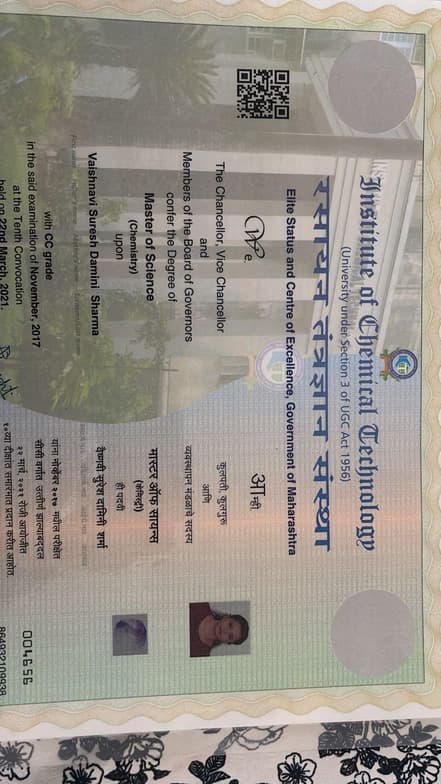
Vaishnavi graduated from Institute of Chemical


AP tutor test prep specialities

AP Scoring Insights

Mock Tests

Grade improvement

Test prep

Test taking techniques
Teaching methodology
My teaching methodology is student-centered, concept-driven, and exam-oriented. I begin by understanding each student’s academic background, learning style, syllabus requirements, and specific goals. Based on this, I design structured lesson plans that focus on building strong conceptual clarity before moving to application-based and exam-level questions. I explain complex Chemistry concepts using simple language, visual representations, flowcharts, and real-life examples to make learning intuitive and engaging. Each topic is taught step by step, ensuring students understand the “why” behind reactions, mechanisms, and calculations rather than relying on memorization. I place strong emphasis on numerical problem-solving, data-based questions, and analytical thinking, which are essential for success in IGCSE, IB, and AP examinations. Regular practice, guided problem-solving, and active questioning are integral parts of my sessions. I provide targeted worksheets, past-paper style questions, and detailed feedback to help students identify and correct mistakes. I also train students in exam strategies such as time management, command-term interpretation, and structured answer writing aligned with mark schemes. My sessions are interactive and supportive, encouraging students to ask questions freely and build confidence. I continuously assess progress and adapt my teaching pace and methods to ensure steady improvement and long-term understanding of Chemistry.
Flexible Scheduling
Allows 1h early scheduling
Allows 1h early rescheduling
Can wait for 20 mins after joining

.svg)
10 day Refund
.svg)
Free Tutor Swap

AP concepts taught by Vaishnavi
The Student and Tutor worked through organic chemistry mechanisms with Grignard reagents and multi-step synthesis. The Student reviewed reactions to synthesize a five-membered ring, including protection and deprotection steps and oxidation. The Student will send another problem set for review in the next session.
Grignard Reagent Reactions
Intramolecular Reactions and Ring Formation
LDA and Enolate Formation
Carbonyl Reactivity and Attack Order
Protecting Groups for Alcohols (TMS)
Oxidation Reactions: Swern vs. Strong Oxidants
The Student and Tutor reviewed organic chemistry reaction mechanisms, focusing on steric hindrance, resonance, and named rearrangements such as the Fries rearrangement. They worked through problems from a practice worksheet, identifying reaction pathways and potential pitfalls. The session concluded with a challenging synthesis question regarding the addition of a methyl group, which was left for further consideration.
Steric Hindrance in Reactions
Resonance and Hybridization
Thermodynamic vs. Kinetic Control
Bond Rotation and Conformational Analysis
Rearrangement Reactions and Aromaticity
Fries Rearrangement Mechanism
The Tutor and Student reviewed the chemical properties and reactions of aldehydes and ketones, focusing on the reactivity of the carbonyl group, methods of synthesis, and nucleophilic addition reactions. They also discussed the use of protecting groups and intramolecular cyclizations, particularly in the context of carbohydrate chemistry. The next sessions are scheduled for Saturday and Sunday evenings to continue these topics.
Carbonyl Group Reactivity
Imine and Enamine Formation
Carbonyl Protection and Selective Reactions
Preparation of Aldehydes and Ketones
Nucleophilic Addition to Carbonyls: Grignard Reagents and Alcohols
The Tutor and Student reviewed definitions and concepts of acids and bases, including Arrhenius and Brønsted-Lowry theories, acid/base strength, and the pH scale. They practiced calculating concentrations and pH for strong and weak acids, and discussed dissociation constants (Ka). Future sessions will focus on further practice questions.
Arrhenius Definition of Acids and Bases
Calculating Ion Concentrations for Weak Acids
Dissociation Constants (Ka and Kb)
The pH Scale and its Measurement
Strength of Acids and Bases
Brønsted-Lowry Definition of Acids and Bases
The Tutor and Student reviewed several organic chemistry concepts including nucleophilic aromatic substitution, oxidation reactions (Swern oxidation), rearrangements (Cope rearrangement), electrophilic addition to alkenes, acidity of functional groups, and multi-step synthesis strategies. They worked through several practice problems, focusing on reaction mechanisms and regioselectivity, with plans to continue practice in the next session.
Friedel-Crafts Acylation and its Role in Synthesis
Acidity of Hydrocarbons and Alcohols
Swern Oxidation and its Limitations
Electrophilic Addition to Alkenes and Carbocation Stability
Nucleophilic Aromatic Substitution
The Student and Tutor reviewed functional group conversions for alkenes and alkynes, covering various reactions and reagents. The Student practiced multi-step synthesis problems, focusing on applying elimination and addition reactions. They discussed Hoffman and Zaitsev elimination products and will continue with synthesis strategies involving carbonyl molecules in future sessions.
Alkene Reactions: Hydrohalogenation
Elimination Reactions: Regioselectivity
Alkyne Reactions: Reduction
Alkyne Reactions: Addition Reactions
Alkyne Reactions: Elimination Reactions
Alkene Reactions: Hydroboration-Oxidation
Alkene Reactions: Hydration
Practical aids used by AP tutor

Digital whiteboard

Presentations

AP Assessments

AP Practice worksheets

Quizzes
Effective AP classes

Chat for quick help

Mobile joining

Parent feedback

Record lessons

Open Q&A

AP tutors on Wiingy are vetted for quality
Every tutor is interviewed and selected for subject expertise and teaching skill.