
Tanya Gupta
Experience Interactive Chemistry Tutor with Diverse Expertise and Engaging Teaching Approach
Loading...



Show all photos
Tanya Gupta
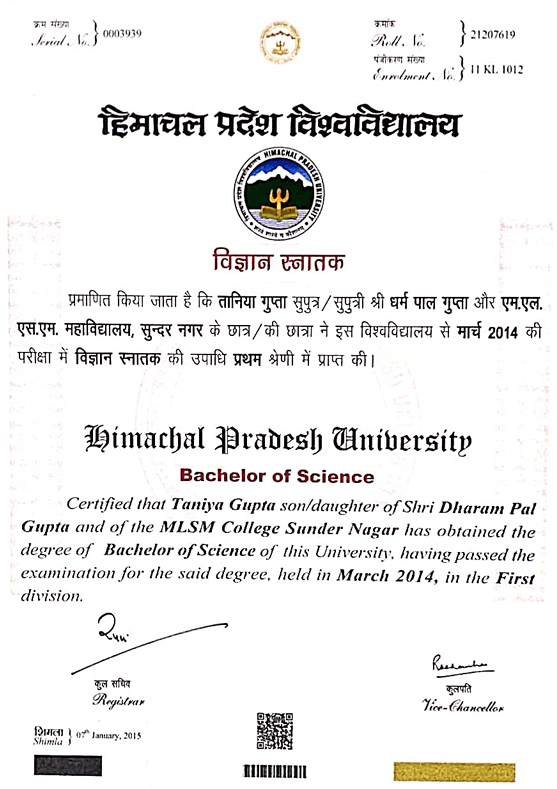
Bachelors degree
Enroll after the free trial
Each lesson is 55 min
50 lessons
20% off
/ lesson
30 lessons
15% off
/ lesson
20 lessons
10% off
/ lesson
10 lessons
5% off
/ lesson
5 lessons
-
/ lesson
1 lessons
-
/ lesson
Tanya Your chemistry tutor
I'm Tanya Gupta, a Chemistry tutor with over 5 years of experience. Armed with a Bachelor's degree, I specialize in Biochemistry, Analytical Chemistry, and more. My tailored approach includes career guidance, real-world applications, and personalized learning plans. From Chemistry experiments to test prep strategies, I cover it all for Elementary to College levels. Let's unravel the mysteries of Chemistry together for a brighter academic journey!
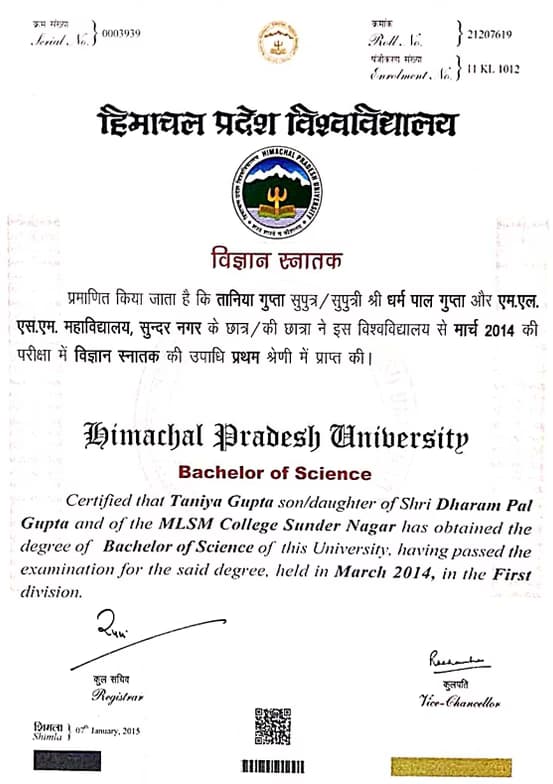
Tanya graduated from MLSM
Specialities of your chemistry tutor

Chemistry experiments

Visual learning

Chemistry lab skills
Review sessions
Types of learners for chemistry class

Anxiety or Stress Disorders

College

All Levels
Elementary School
High School
Middle School
Chemistry class overview
My tutoring style focuses on patience, structured conceptualization, and interactive engagement. I specialize in teaching a variety of science subjects including Atomic Structure, Organic Chemistry, and Biochemistry. To enhance learning, I utilize tech tools like digital whiteboards, interactive 3D models, and online quizzes. I follow various curricula such as A-Levels, AP Program, and IB to cater to a diverse student base of over 200 students ranging from elementary to college levels. My approach fosters personalized tutoring, ensuring students grasp complex concepts effectively through interactive lessons and tailored assessments, leading to their academic success.
Your chemistry tutor also teaches

Chemistry
Organic Chemistry
Chemical Reactions
Analytical Chemistry
Atomic Structure
Biochemistry
Flexible Scheduling
Allows 1h early scheduling
Allows 1h early rescheduling
Can wait for 20 mins after joining

.svg)
10 day Refund
.svg)
Free Tutor Swap

Chemistry concepts taught by Tanya
The Student and Tutor reviewed redox titrations, focusing on balancing equations for reactions involving potassium permanganate and iron or oxalate using the oxidation number method. They then transitioned to catalysts, discussing heterogeneous and homogeneous types, with examples like the Contact Process and iron-catalyzed reactions, and exploring the concept of absorption in heterogeneous catalysis.
Transition Metals: Properties as Catalysts
Catalysis: Homogeneous vs. Heterogeneous
Redox Titration: Permanganate and Iron
The Tutor and Student reviewed IR spectroscopy, covering characteristic absorption peaks for various functional groups like alcohols, amines, nitriles, and carbonyls. They practiced interpreting spectra to differentiate between primary, secondary, and tertiary amines and identifying the functional group versus fingerprint regions. The Tutor planned to share additional graphs for further observation.
Characteristic IR Absorption Bands
IR Spectrum Regions: Functional Group vs. Fingerprint
Distinguishing Primary
Secondary
and Tertiary Amines by IR
IR Spectroscopy: Wavelength and Wave Number Relationship
The class covered organic chemistry topics including IUPAC nomenclature, conformational analysis, stereochemistry (chirality, R/S configuration, enantiomers, diastereomers, meso compounds), and isomerism. The student practiced naming compounds, analyzing conformations, and determining stereochemical relationships, with plans to cover IR spectroscopy in a future session.
IUPAC Naming of Alkanes
Cyclic Alkanes: Nomenclature and General Formula
Constitutional Isomers of Alkanes
Conformations and Stability
Chirality
Enantiomers
and Diastereomers
The Tutor and Student reviewed the definitions and theories of acids and bases, focusing on Arrhenius and Brønsted-Lowry concepts, conjugate pairs, and the strength of acids and bases relative to their conjugates. They also explored the quantitative measures of acidity (Ka, pKa) and introduced the pH scale derived from the ionic product of water, with plans to work on practice problems for calculating pH.
Strength of Acids and Bases & Their Conjugates
Acid Dissociation Constant (Ka) and pKa
pH Scale and the Ionic Product of Water (Kw)
Bronsted-Lowry Acid-Base Theory
The tutor and student reviewed condensation polymers, focusing on the formation, examples (polyamides like nylon and Kevlar, polyesters like Terylene, and polypeptides), and the mechanism of hydrolysis. They also briefly discussed the uses of condensation polymers and planned to cover more questions and uses in the next session.
Peptide Linkage and Polypeptides
Uses of Condensation Polymers
Hydrolysis of Polymers
Polyesters
Polyamides
Condensation Polymers
The Student and Tutor reviewed concepts in organic chemistry, including chirality, meso compounds, R/S configurations, stereoisomers, and enantiomeric excess. They also discussed reaction mechanisms, bond cleavage, enthalpy changes, and types of reactions (substitution, addition, elimination). The session involved problem-solving and conceptual explanations to aid the Student's understanding of these topics.
Chirality and Symmetry Elements
Meso Compounds
R and S Configuration (Cahn-Ingold-Prelog Rules)
Stereoisomers and 2ⁿ Rule
Enantiomers
Diastereomers
and Constitutional Isomers
Racemic Mixtures and Anomeric Excess
Tools & techniques used by chemistry tutor

Assessments
Interactive diagrams

Practice worksheets

Presentations

Quizzes
Interactive chemistry lessons

Open Q&A

Parent feedback

Chat for quick help

Record lessons

Chemistry tutors on Wiingy are vetted for quality
Every tutor is interviewed and selected for subject expertise and teaching skill.