
Vaishnavi Sharma
Fostering scientific thinking through conceptual clarity, inquiry, and real-world application.
Loading...




Show all photos
Vaishnavi Sharma
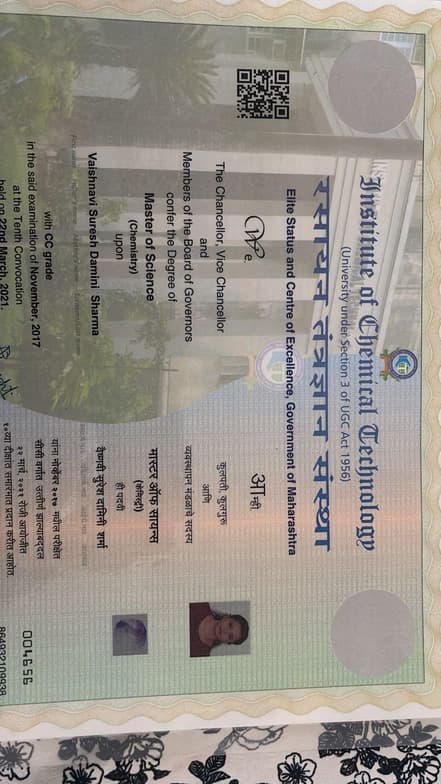
Masters degree
Enroll after the free trial
Each lesson is 55 min
50 lessons
20% off
/ lesson
30 lessons
15% off
/ lesson
20 lessons
10% off
/ lesson
10 lessons
5% off
/ lesson
5 lessons
-
/ lesson
1 lessons
-
/ lesson
Vaishnavi Your chemistry tutor
I have 14+ years of experience teaching Chemistry across multiple boards including IGCSE, A-Levels, AS-Levels, IB, and HSC, along with preparing students for competitive exams like JEE and NEET. I completed my MSc in Chemistry by Research from ICT, Mumbai University, which helped shape my analytical and subject expertise. I have worked with students in both India and the UK through full-time tutoring roles, and I focus on breaking down complex concepts into simple, relatable explanations. Teaching has allowed me to merge subject mastery with mentorship, and I enjoy designing engaging learning experiences that build confidence and conceptual depth. I am deeply committed to student-centric teaching methodologies and continuous academic innovation. I am passionate about making Chemistry engaging, student-friendly, and relevant to real-world learning.
Vaishnavi graduated from Institute of Chemical


Specialities of your chemistry tutor

GCSE (UK)

Career guidance

Chemistry experiments
Review sessions

Homework help

A-Levels (UK)
Visual learning

Chemistry lab skills
Personalized learning plans
Types of learners for chemistry class

Home schooled

College students
High School students
Chemistry class overview
Chemistry is often perceived as a subject heavy in memory work, equations, and abstract theories. To counter this misconception, I always begin by establishing a strong conceptual foundation through intuitive analogies, guided questioning, and relatable examples. Rather than giving definitions first, I help students experience why a concept exists. Once reasoning is established, technical language and formal definitions follow naturally. This promotes durable learning and prevents rote recall. Students grasp faster when Chemistry is connected to daily life. I routinely relate topics to examples from medicine, food chemistry, materials science, sustainability, environmental issues, cosmetics formulation, and industry applications. This broadens perspective and demonstrates relevance. For advanced learners, I occasionally incorporate short research-based discussions linking textbook concepts to current scientific developments (battery chemistry, polymers, pharmaceuticals, spectroscopy, green chemistry etc.). This instills a research mindset early.
Your chemistry tutor also teaches

Chemistry
Organic Chemistry
Chemical Reactions
Physical Chemistry
Inorganic Chemistry
Analytical Chemistry
Flexible Scheduling
Allows 1h early scheduling
Allows 1h early rescheduling
Can wait for 20 mins after joining

.svg)
10 day Refund
.svg)
Free Tutor Swap

Chemistry concepts taught by Vaishnavi
The student and tutor reviewed calculations related to weak acid and base dissociation, pH, and pOH. They then transitioned to understanding and calculating solubility products (Ksp) for sparingly soluble salts. The student will continue practicing these concepts, with a plan to cover the common ion effect and buffers in the next session.
Ksp Expression Derivation for Different Salt Formulas
pH and pOH Calculations for Bases
Percentage Dissociation of Weak Acids
Solubility Product (Ksp)
The Student and Tutor worked through organic chemistry mechanisms with Grignard reagents and multi-step synthesis. The Student reviewed reactions to synthesize a five-membered ring, including protection and deprotection steps and oxidation. The Student will send another problem set for review in the next session.
Grignard Reagent Reactions
Intramolecular Reactions and Ring Formation
LDA and Enolate Formation
Carbonyl Reactivity and Attack Order
Protecting Groups for Alcohols (TMS)
Oxidation Reactions: Swern vs. Strong Oxidants
The Student and Tutor reviewed organic chemistry reaction mechanisms, focusing on steric hindrance, resonance, and named rearrangements such as the Fries rearrangement. They worked through problems from a practice worksheet, identifying reaction pathways and potential pitfalls. The session concluded with a challenging synthesis question regarding the addition of a methyl group, which was left for further consideration.
Fries Rearrangement Mechanism
Rearrangement Reactions and Aromaticity
Bond Rotation and Conformational Analysis
Resonance and Hybridization
Steric Hindrance in Reactions
Thermodynamic vs. Kinetic Control
The Tutor and Student reviewed the chemical properties and reactions of aldehydes and ketones, focusing on the reactivity of the carbonyl group, methods of synthesis, and nucleophilic addition reactions. They also discussed the use of protecting groups and intramolecular cyclizations, particularly in the context of carbohydrate chemistry. The next sessions are scheduled for Saturday and Sunday evenings to continue these topics.
Carbonyl Group Reactivity
Imine and Enamine Formation
Carbonyl Protection and Selective Reactions
Preparation of Aldehydes and Ketones
Nucleophilic Addition to Carbonyls: Grignard Reagents and Alcohols
The Tutor and Student reviewed definitions and concepts of acids and bases, including Arrhenius and Brønsted-Lowry theories, acid/base strength, and the pH scale. They practiced calculating concentrations and pH for strong and weak acids, and discussed dissociation constants (Ka). Future sessions will focus on further practice questions.
Arrhenius Definition of Acids and Bases
Brønsted-Lowry Definition of Acids and Bases
Strength of Acids and Bases
The pH Scale and its Measurement
Dissociation Constants (Ka and Kb)
Calculating Ion Concentrations for Weak Acids
The Tutor and Student reviewed several organic chemistry concepts including nucleophilic aromatic substitution, oxidation reactions (Swern oxidation), rearrangements (Cope rearrangement), electrophilic addition to alkenes, acidity of functional groups, and multi-step synthesis strategies. They worked through several practice problems, focusing on reaction mechanisms and regioselectivity, with plans to continue practice in the next session.
Nucleophilic Aromatic Substitution
Friedel-Crafts Acylation and its Role in Synthesis
Acidity of Hydrocarbons and Alcohols
Electrophilic Addition to Alkenes and Carbocation Stability
Swern Oxidation and its Limitations
Tools & techniques used by chemistry tutor

Assessments
Video conferencing

Flashcards
Digital Note taking
Interactive 3D models
Interactive diagrams

Presentations
Interactive chemistry lessons

Parent feedback

Mobile joining

Open Q&A

Note taking

Chat for quick help

Chemistry tutors on Wiingy are vetted for quality
Every tutor is interviewed and selected for subject expertise and teaching skill.