
Tribhuvan Prasad
From IIT Hyderabad to the World: Making Chemistry Clear, Logical, and Exciting for Every Student
Loading...






Show all photos
Tribhuvan Prasad
Masters degree
Enroll after the free trial
Each lesson is 55 min
50 lessons
20% off
/ lesson
30 lessons
15% off
/ lesson
20 lessons
10% off
/ lesson
10 lessons
5% off
/ lesson
5 lessons
-
/ lesson
1 lessons
-
/ lesson
Tribhuvan Your chemistry tutor
Hello everyone! My name is Tribhuvan Prasad, and I’m currently pursuing my Master’s degree in Chemistry at the Indian Institute of Technology, Hyderabad (IIT Hyderabad) — one of India’s most prestigious institutes for science and research. My journey with chemistry began from pure curiosity, and over time, it transformed into a deep passion for understanding the molecular world. Today, as both a researcher and an educator, my mission is simple — to make chemistry intuitive, logical, and truly enjoyable for students around the world. I specialize in teaching AP Chemistry, IB Chemistry (SL & HL), A-Level, IGCSE, MCAT, CSIR-NET, IIT-JAM, and university-level chemistry courses. Having taught students from India, the US, Canada, the UK, Singapore, and the Middle East, I’ve developed an adaptive teaching approach that works for different boards, learning styles, and academic goals. Whether you’re preparing for an exam or trying to fall in love with the subject, I focus on helping you build clarity and confidence through deep understanding.
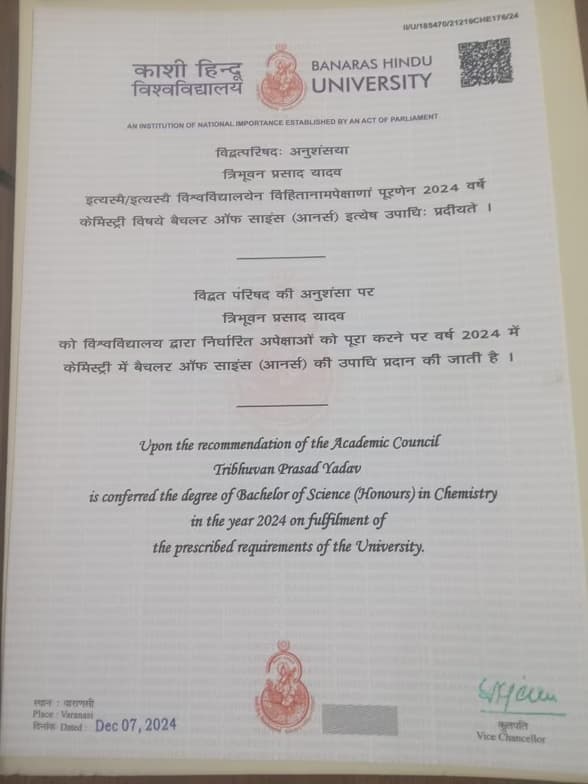
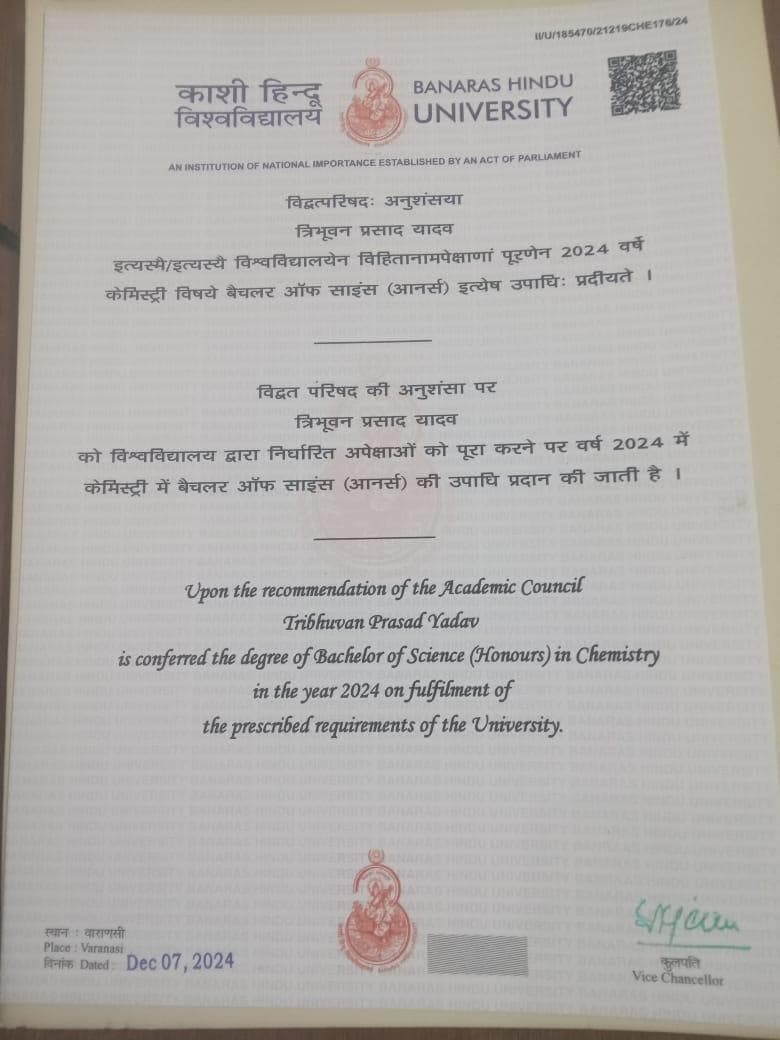
Tribhuvan graduated from IIT HYDERABAD
Specialities of your chemistry tutor

Advanced Placement (AP) Program (USA)

Common Core State Standards - CCSS (USA)

Provincial-specific curriculum (CA)

Visual learning

Chemistry lab skills

GCSE (UK)

State-Specific Standards (USA)
Real world application
Test prep strategies
Review sessions
Career guidance

International Baccalaureate (IB)
Types of learners for chemistry class

ADHD

High School students

Anxiety or Stress Disorders

Home schooled
College students
Chemistry class overview
My teaching philosophy revolves around three principles: Understand First, Memorize Later — Chemistry makes sense when you know why things happen, not just how. Learn Visually — I use examples from my own research, industrial processes, and daily life to explain complex topics. Build Confidence — I create a safe, interactive environment where mistakes are part of learning, and curiosity is encouraged. I want every student to think like a scientist — questioning, visualizing, and connecting ideas. Once that mindset develops, chemistry stops being difficult and starts being fascinating. Every equation in chemistry has a reason behind it, every reaction has a mechanism, and every concept connects to something we experience daily. I try to make my classes interactive and visual — using examples from industry, environmental science, and even my own research — so that students can see how theory and application fit together. I want them to think like scientists, not just students preparing for exams. Another principle I strongly believe in is confidence through clarity. Many students find chemistry intimidating, but once they understand its logic, the fear disappears. I make sure that each topic, no matter how complex — whether it’s molecular orbital theory, quantum chemistry, or kinetics — is explained in a way that feels natural and approachable. My classes are conversation-based, where students are free to ask “why” at every step. I also emphasize problem-solving strategies and pattern recognition, so they develop analytical skills that stay useful beyond any exam.
Your chemistry tutor also teaches
Chemistry
Organic Chemistry
Chemical Reactions
Physical Chemistry
Inorganic Chemistry
Analytical Chemistry
Flexible Scheduling
Allows 1h early scheduling
Allows 1h early rescheduling
Can wait for 20 mins after joining

.svg)
10 day Refund
.svg)
Free Tutor Swap

Chemistry concepts taught by Tribhuvan
The tutor and student reviewed concepts in acid-base chemistry, including the relationship between Ka and acid strength, reaction equilibria, and the strength of conjugate bases. They practiced solving problems involving acid-base comparisons, equilibrium constant calculations, and determining ion concentrations, preparing for an upcoming exam.
Conjugate Acid-Base Pairs
Calculating KB from Ka
Predicting Reaction Direction
Factors Affecting Oxoacid Strength
Acid Strength and pKa
Acid Strength and Ka
The Tutor and Student worked through various problems related to acid-base chemistry, focusing on definitions of acids and bases, conjugate pairs, and calculations involving pH, pOH, K_a, and K_b. They also briefly touched upon the self-ionization of water and equilibrium principles.
Acid-Base Definitions: Arrhenius
Brønsted-Lowry
and Lewis
Conjugate Acid-Base Pairs
pH and pOH Scales
Acid Dissociation Constant (Ka) and Base Dissociation Constant (Kb)
Water's Autoionization and Kw
The Tutor and Student reviewed concepts in acid-base chemistry, including titration curves, acid dissociation constants (Ka), the pH of salt solutions, and calculations involving weak acids. They practiced determining acid strength and calculating pH for various solutions, and discussed identifying the relative strengths of conjugate acid-base pairs in equilibrium reactions.
Titration Curves and Concentration Effects
pH
pOH
and the Ion Product of Water
Acid Dissociation Constant (Ka) and Acid Strength
Strong Electrolytes vs. Weak Electrolytes
The Tutor and Student worked through several quantitative problems in Chemistry related to acid-base titrations. They practiced calculating H+ and OH- concentrations from pH, determining moles of reactants, and applying the Henderson-Hasselbeck equation. The session concluded with calculations involving mass percentage and understanding the nature of solutions at the equivalence point.
pH and H⁺ Concentration
pOH and OH⁻ Concentration
Calculating Moles from Molarity and Volume
The Henderson-Hasselbalch Equation
Equivalence Point and Solution Nature
Calculating Mass and Percentage Composition
The Tutor and Student reviewed AP Chemistry topics including isomerism, nomenclature, boiling points, and chemical equilibrium. They practiced solving problems related to equilibrium constants, ideal gas law, Le Chatelier's principle, and spectrophotometry, with a focus on the upcoming test. The Tutor offered to share class notes.
Le Chatelier's Principle and Equilibrium Shifts
Spectrophotometry and Beer-Lambert Law
Ideal Gas Law and Partial Pressures
Factors Affecting Boiling Point: Molecular Weight and Branching
Chemical Equilibrium and Equilibrium Constant (Kc)
The tutor and student reviewed organic reaction mechanisms, including Swern oxidation and condensation reactions involving amines and aldehydes. They practiced identifying nucleophiles and electrophiles and discussed the steps involved in forming intermediates and final products. The session concluded with plans for further study and practice, including reviewing notes and potentially scheduling a longer session.
Protection and Deprotection Strategies
Condensation Reactions: Formation of Imines and Enamines
Role of Bases in Organic Reactions (LDA)
The Swern Oxidation Mechanism
Reaction Mechanisms: Nucleophile & Electrophile
Tools & techniques used by chemistry tutor

Assessments

Digital whiteboard

Practice worksheets

Quizzes
Video conferencing

Presentations
Interactive chemistry lessons

Mobile joining

Chat for quick help

Chemistry tutors on Wiingy are vetted for quality
Every tutor is interviewed and selected for subject expertise and teaching skill.