
Elbright Dillu
Qualified and Experienced Chemistry Tutor: Helping students build strong foundations.
Loading...





Show all photos
Elbright Dillu
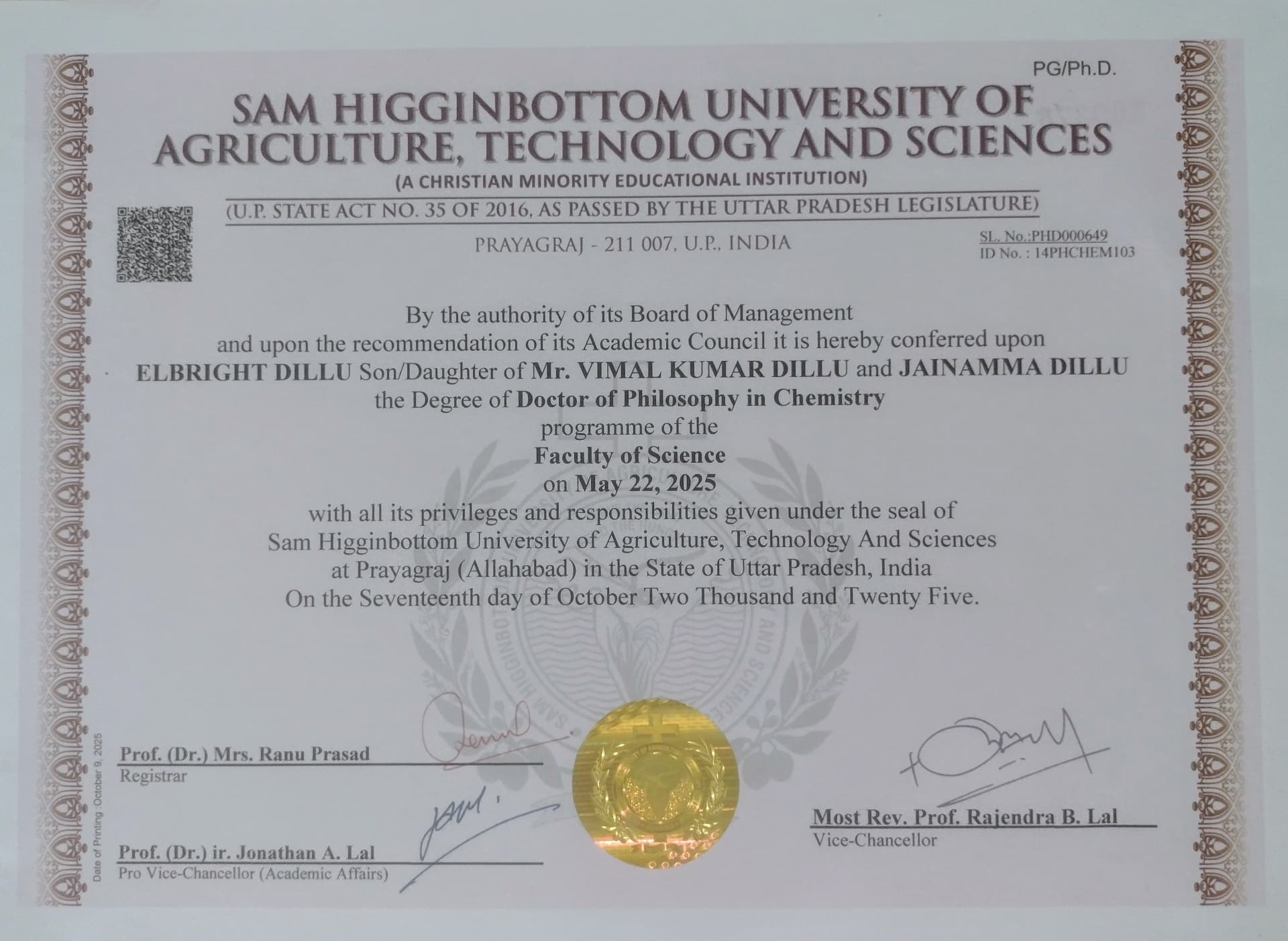
Doctorate degree
Enroll after the free trial
Each lesson is 55 min
50 lessons
20% off
/ lesson
30 lessons
15% off
/ lesson
20 lessons
10% off
/ lesson
10 lessons
5% off
/ lesson
5 lessons
-
/ lesson
1 lessons
-
/ lesson
Elbright Your chemistry tutor
Hi! I’m Elbright Dillu, and I’m excited to help you discover how interesting and logical Chemistry can really be. I hold a Doctoral degree in Chemistry, specializing in Nanochemistry, and I teach across all the core areas — Inorganic, Organic, Physical, and Analytical Chemistry. I’ve worked with high school and college students for over a decade, and my goal is to help my students reach that point, where they truly understand what’s happening, not just memorize it for an exam. In my sessions, I focus on clarity, patience, and real understanding. We’ll go step by step through concepts, discuss how and why reactions occur, and relate what you learn in class to how Chemistry works in real life. I believe every student can learn Chemistry with the right guidance and mindset. I adapt my teaching style to suit how my students learn best whether that means slowing down to strengthen their basics or going deeper into advanced topics. The aim is always the same — to make my pupils confident and comfortable with the subject. If you’re a high school or college student looking for a supportive, easy-to-approach tutor who’ll help you build a strong foundation and enjoy learning along the way, I’d love to work with you. Let’s make Chemistry something you look forward to mastering — together.
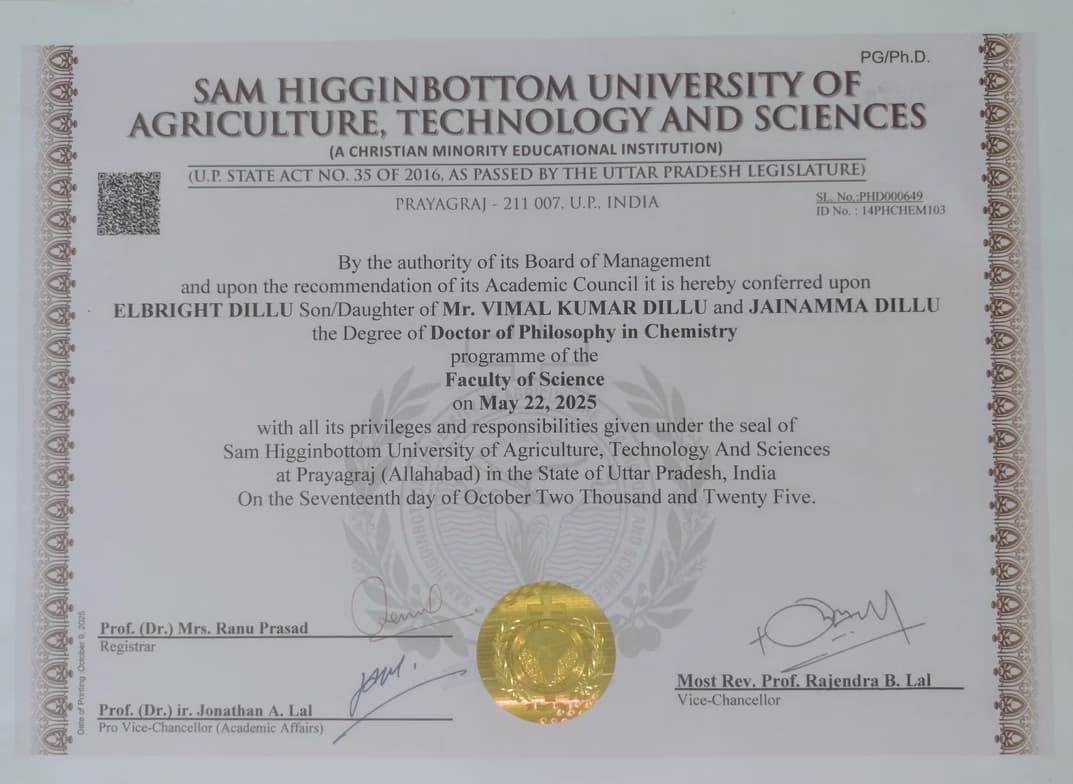
Elbright graduated from Sam Higginbottom University of Agriculture, Technology & Sciences

Specialities of your chemistry tutor

Review sessions
Real world application

Chemistry experiments

Homework help

Chemistry lab skills
Types of learners for chemistry class

Home schooled

High School students
College students
Chemistry class overview
My teaching approach is structured yet flexible, with a strong focus on building a clear understanding of core concepts. I believe that once students grasp the fundamentals, they can think more critically and explore Chemistry with confidence and curiosity. To make learning engaging and effective, I use tools like digital whiteboards and PowerPoint presentations, which help visualize reactions, mechanisms, and problem-solving steps in a clear and interactive way. My lessons follow a curriculum that adapts to each student’s goals — whether they’re preparing for exams, strengthening basics, or advancing their subject knowledge. I also conduct regular assessments and feedback sessions to track progress and identify areas for improvement. Over the past 11+ years, I’ve had the opportunity to mentor more than 200 students, through both undergraduate classroom teaching and one-on-one tutoring for high school learners. This experience has helped me develop a teaching style that’s not only result-oriented but also student-centered and encouraging. I always welcome feedback from my students and make it a point to incorporate their suggestions into future lessons. My goal is to create a supportive and engaging environment where students feel comfortable asking questions, learning at their own pace, and truly enjoying the subject.
Your chemistry tutor also teaches

Chemistry
Organic Chemistry
Chemical Reactions
Physical Chemistry
Inorganic Chemistry
Analytical Chemistry
Flexible Scheduling
Allows 1h early scheduling
Allows 1h early rescheduling
Can wait for 20 mins after joining

.svg)
10 day Refund
.svg)
Free Tutor Swap

Chemistry concepts taught by Elbright
The tutor and student reviewed molecular orbital theory, focusing on the formation of bonding and anti-bonding orbitals, MO diagrams for diatomic molecules, and the calculation of bond order. They practiced applying these concepts to various diatomic species and their ions, and discussed the difference between MO diagrams for O2/F2 and B2/C2/N2.
Bond Order Calculation
MO Diagrams for Diatomic Molecules
Bonding and Anti-bonding Orbitals
Atomic vs. Molecular Orbitals
The student and tutor reviewed and practiced predicting molecular geometry using hybridization and VSEPR theory. They worked through examples like BeCl2, BF3, CH4, NH3, H2O, PCl5, SF6, and SO2, focusing on determining hybridization and geometry. A study plan was established to complete Chapter 8 homework and prepare for an upcoming test.
Valence Shell Electron Configurations & Hybridization
Molecular Geometry and VSEPR Theory
Sigma and Pi Bonds in Hybridization
The Tutor and Student worked through AP Chemistry problems focusing on acid-base equilibrium and salt hydrolysis. They practiced determining whether anions and cations would create acidic, basic, or neutral solutions and calculated pH values. The next session will continue with similar AP-level problems.
Anions Acting as Weak Bases
Salt Hydrolysis and pH Determination
Relationship between Ka
Kb
and Kw
The tutor and student worked through a series of chemistry practice problems covering acid-base reactions, chemical kinetics, phase changes, gas laws, equilibrium principles, solubility products, buffer solutions, thermochemistry, and reaction rates. They reviewed concepts like elementary steps, rate-determining steps, boiling points, Le Chatelier's principle, Ksp, and Hess's Law, with a plan to focus on chemical kinetics in the next session.
Solubility Product (Ksp)
Activation Energy and Reaction Rate
Buffer Solutions and pH Stability
Boiling Point and Vapor Pressure Relationship
Elementary Steps and Rate Laws
The tutor and student reviewed organic chemistry practice problems, focusing on nomenclature, reaction mechanisms, stereochemistry, degree of unsaturation, polymerization, and heats of hydrogenation. They discussed specific examples and clarified concepts for an upcoming exam.
Polymerization Mechanism: Ethylene
Heats of Hydrogenation and Alkene Stability
Stereochemistry of Halogenation and Diastereomers
Degree of Unsaturation (Index of Hydrogen Deficiency)
Periodic Acid Cleavage of Diols
Epoxide Formation and Hydrolysis
Alkene Naming: Priority Rules and Nomenclature
The tutor and student reviewed organic chemistry concepts, including nomenclature, carbocation and alkene stability, and various reaction mechanisms. They practiced naming compounds, ranking stability based on structural features, and identifying reagents and products for reactions like dihydroxylation, dehydration, and elimination. The next session will focus on reaction mechanisms.
Carbocation Stability and Hyperconjugation
Alkene Stability
Anti-Dihydroxylation of Alkenes
Dehydration of Alcohols
Oxidative Cleavage of Vicinal Diols
Tools & techniques used by chemistry tutor

Assessments

Practice worksheets
Interactive diagrams

Presentations
Video conferencing
Interactive chemistry lessons

Open Q&A

Pets are welcomed

Note taking

Chat for quick help

Record lessons

Chemistry tutors on Wiingy are vetted for quality
Every tutor is interviewed and selected for subject expertise and teaching skill.